


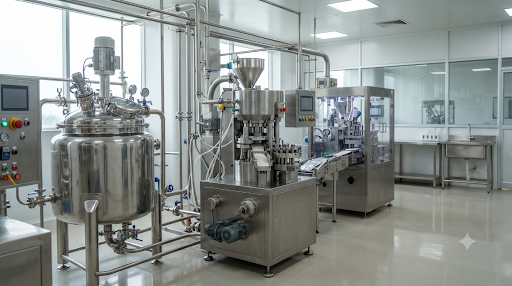
The pharmaceutical industry depends on specialized equipment to manufacture tablets, capsules, powders, granules, liquids, and other dosage forms safely and consistently. However, pharmaceutical machinery costs can vary significantly depending on machine type, production capacity, automation level, material of construction, GMP requirements, customization, and installation requirements.
For pharmaceutical companies planning a new manufacturing facility or upgrading an existing production line, understanding the cost of pharmaceutical machinery is essential for preparing an accurate project budget.
This guide explains the major factors affecting pharmaceutical machinery prices, provides an overview of commonly used machines, and discusses what buyers should consider when selecting a pharmaceutical machinery manufacturer in India.
Pharmaceutical machinery refers to specialized equipment used for processes such as dispensing, mixing, granulation, drying, milling, blending, compression, coating, filling, and packaging of pharmaceutical products.
Depending on the manufacturing process, a pharmaceutical plant may require equipment such as:
The total investment depends on the combination of machines required for a particular production process.
There is no single fixed price for pharmaceutical machinery. Two machines performing similar functions can have substantially different prices because of differences in design, capacity, automation, construction material, and compliance requirements.
The major factors influencing pharmaceutical machinery cost include:
1. Machine Type: Different machines have different manufacturing complexities. For example, a laboratory-scale blender generally costs less than a high-capacity automated production blender.
Similarly, the cost of a tablet compression machine can vary considerably based on the number of stations, output capacity, tooling configuration, automation, and control system.
2. Production Capacity: Capacity is one of the most important pricing factors.
A machine designed for a small batch may require a relatively modest investment, while industrial-scale pharmaceutical machinery with higher batch capacity requires larger vessels, stronger drives, advanced controls, and more sophisticated safety systems.
Before purchasing equipment, manufacturers should determine:
3. Material of Construction: Pharmaceutical equipment is commonly manufactured using stainless steel, particularly grades selected according to product-contact and process requirements.
The material specification can influence the final cost through:
Higher specifications for product-contact surfaces generally increase the overall equipment investment.
4. Automation Level: Manual, semi-automatic, and fully automatic machines have different price points.
Advanced automation may include:
Although automation increases the initial investment, it can improve process consistency and reduce manual intervention.
5. GMP Requirements: GMP-compliant machinery cost depends on the level of design and documentation required for the pharmaceutical manufacturing facility.
GMP-oriented equipment may require features such as:
Therefore, buyers should compare machines based on total compliance and functionality rather than simply choosing the lowest quoted price.
The following categories provide a general framework for understanding pharmaceutical equipment investment. Actual prices can vary significantly based on capacity, configuration, automation, material specifications, customization, and supplier.
| Pharmaceutical Machine | Main Application | Key Factors Affecting Cost |
| Rapid Mixer Granulator | Wet granulation and mixing | Capacity, drive system, automation, construction |
| Fluid Bed Dryer | Drying of granules | Air handling, capacity, automation, filtration |
| Pharmaceutical Blender | Powder blending | Capacity, blender design, drive and discharge system |
| Multi Mill | Size reduction | Capacity, screen configuration, drive |
| Tablet Compression Machine | Tablet production | Number of stations, output, automation |
| Tablet Coating Machine | Tablet coating | Pan capacity, spray system, automation |
| Manufacturing Vessel | Mixing and manufacturing | Volume, agitator, material and heating/cooling |
| Capsule Filling Machine | Capsule production | Output, automation and capsule format |
These should be treated as budgeting categories rather than fixed market prices, because pharmaceutical equipment is often engineered according to the customer's process requirements.
A Rapid Mixer Granulator (RMG) is widely used in pharmaceutical manufacturing for mixing and wet granulation.
The rapid mixer granulator price can depend on:
A small RMG for a lower batch size will naturally require a different investment than a high-capacity production model. When comparing RMG quotations, buyers should evaluate the complete technical specification rather than comparing only the quoted price.
A Fluid Bed Dryer (FBD) is used to dry wet granules and other pharmaceutical materials under controlled process conditions.
The fluid bed dryer price can depend on:
For pharmaceutical applications, the equipment should be selected according to the product's drying characteristics and required process parameters.
Pharmaceutical blenders are used to achieve uniform mixing of powders and granules.
The pharmaceutical blender machine price depends on factors such as:
Common blender configurations include octagonal blenders, bin blenders, conta blenders, and other customized mixing systems.
A higher-capacity or highly automated blender generally requires a greater investment than a basic configuration.
India has become an important manufacturing base for pharmaceutical processing equipment. As a result, buyers can find a wide range of pharmaceutical equipment manufacturers and suppliers offering machines for domestic and international pharmaceutical projects.
Pharmaceutical machinery cost in India is influenced by both technical specifications and project requirements.When obtaining quotations from Indian manufacturers, customers should provide details such as:
Providing these details helps manufacturers prepare a more accurate quotation.
A common mistake when purchasing pharmaceutical equipment is comparing quotations only by price. Two suppliers may quote different prices because their machines differ in:
Therefore, the lowest quotation is not necessarily the most economical solution in the long term.
A better approach is to compare the total value of the equipment, including performance, reliability, maintenance, compliance, service, and expected operating life.
Selecting the right pharmaceutical machinery manufacturer in India is an important decision because the equipment can directly influence manufacturing efficiency and product quality.
Before finalizing a supplier, consider the following:
There is no single manufacturer that is automatically the best pharmaceutical machinery manufacturer in India for every project. The right manufacturer should be selected based on the specific requirements of the pharmaceutical facility.
A good manufacturer should offer a combination of:
Buyers should request detailed technical quotations and compare suppliers based on both specifications and commercial terms.
India has numerous pharmaceutical machinery suppliers in India serving pharmaceutical manufacturers, contract manufacturing companies, nutraceutical manufacturers, and other processing industries.
When evaluating suppliers, ask the following questions:
These questions can help distinguish an experienced equipment manufacturer from a supplier focused primarily on trading.
When searching for pharmaceutical machinery manufacturers in India, customers should prepare a technical comparison sheet.
A useful comparison can include:
| Evaluation Parameter | Supplier A | Supplier B | Supplier C |
| Machine capacity | Compare | Compare | Compare |
| Material of construction | Compare | Compare | Compare |
| Surface finish | Compare | Compare | Compare |
| Automation | Compare | Compare | Compare |
| GMP requirements | Compare | Compare | Compare |
| Documentation | Compare | Compare | Compare |
| Installation | Compare | Compare | Compare |
| Warranty | Compare | Compare | Compare |
| Spare parts | Compare | Compare | Compare |
| Delivery timeline | Compare | Compare | Compare |
| Total cost | Compare | Compare | Compare |
This approach provides a better purchasing decision than comparing only the initial quotation.
For pharmaceutical manufacturers, GMP compliance is an important consideration when designing manufacturing equipment and facilities.
The GMP-compliant machinery cost can be higher than standard industrial equipment because the machine may require enhanced hygienic design, suitable materials, improved surface finish, documentation, testing, and other project-specific requirements.
However, the cost should be evaluated as part of the overall manufacturing system rather than as an unnecessary additional expense.
Properly designed equipment can support:
The exact requirements should always be determined according to the applicable regulatory framework, product, process, and customer specifications.
India's pharmaceutical engineering sector serves not only domestic pharmaceutical companies but also international customers.
Chamunda Pharma Machinery Pvt. Ltd. manufactures pharmaceutical machinery in India and serves customers in international markets. Indian pharmaceutical equipment manufacturers can support projects requiring equipment for different production capacities, process requirements, and technical specifications.
Pharmaceutical machinery manufactured in India can be supplied for international markets including Uzbekistan, Germany, Indonesia, Iraq, Israel, Jordan, the Philippines, the USA, and Vietnam, subject to project specifications, applicable regulations, import requirements, and customer standards.
For export projects, buyers should discuss:
Export experience can be particularly valuable when equipment needs to be shipped, installed, commissioned, and supported outside India.
Reducing equipment investment does not necessarily mean choosing the cheapest machine. Businesses can optimize their budget by:
Clearly specify capacity, process requirements, automation, material, and compliance requirements.
Customization should solve a genuine process or operational requirement. Unnecessary modifications can increase both cost and delivery time.
Buying equipment that is too small may require an early replacement or expansion. Evaluate expected production growth before selecting the machine size.
Consider:
Direct communication with an experienced manufacturer can simplify technical discussions and reduce unnecessary intermediaries.
The cost of pharmaceutical machinery depends on much more than the machine's basic specifications. Capacity, material of construction, automation, GMP requirements, customization, documentation, installation, and after-sales support can all influence the final investment.
Whether you are looking for a Rapid Mixer Granulator, Fluid Bed Dryer, pharmaceutical blender, tablet manufacturing machine, or complete pharmaceutical processing equipment, it is important to compare suppliers based on technical specifications and total value.
Chamunda Pharma Machinery Pvt. Ltd. can be considered when evaluating pharmaceutical machinery manufacturing requirements in India and international markets. Businesses should discuss their specific process, capacity, GMP, and export requirements with the manufacturer to obtain an accurate technical and commercial proposal.
Explore more insights and updates from our blog section.
Pharmaceutical manufacturing depends on equipment that can consistently produce safe, effective, and high-quality products. From...
Read MoreThe pharmaceutical industry depends on specialized equipment to manufacture tablets, capsules, powders, granules, liquids, and...
Read MoreAs battery manufacturing continues to expand across India, the USA, Europe, and Brazil, manufacturers are...
Read More


 info@chamunda.in
 +91-9512004254 / 55 / 56


