


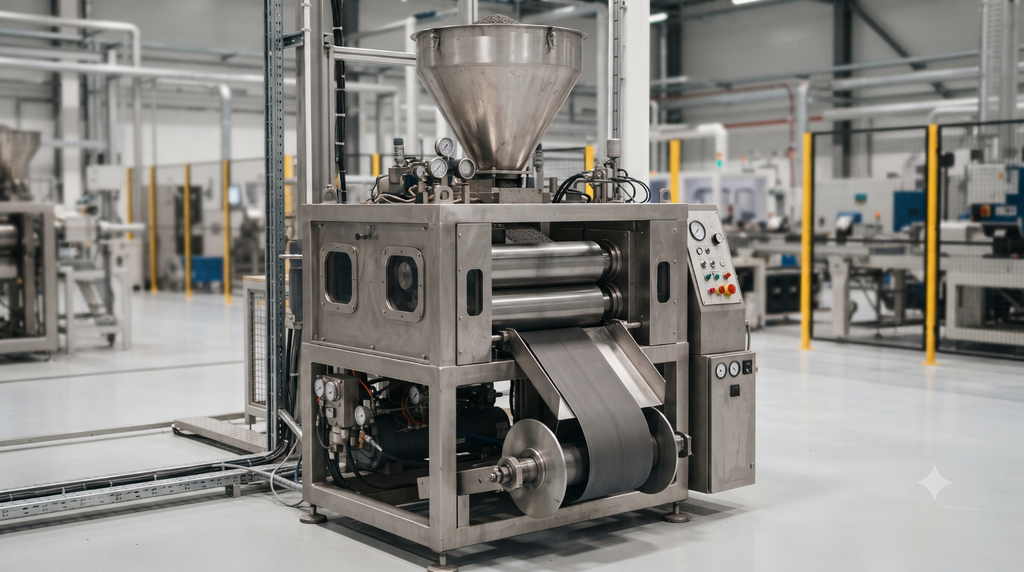
The rapid growth of electric vehicles, energy storage systems, consumer electronics, and renewable-energy applications is increasing the demand for efficient battery manufacturing technologies. Along with electrode chemistry and cell design, the way battery powders are handled, processed, densified, and transferred can have a significant impact on manufacturing efficiency.
A Roll Compactor for Battery Manufacturing is an important dry-processing technology for suitable battery powders. It uses controlled mechanical pressure to convert fine powder into a compacted ribbon, flake, or sheet, which can then be milled and screened into granules with the required characteristics.
For battery-material manufacturers looking to improve powder handling, bulk density, feeding consistency, and dry granulation, roll compaction can become an important part of an integrated powder-processing system.
A roll compactor is a dry granulation machine that continuously compresses powder between two counter-rotating rolls. The controlled pressure densifies the powder and forms a compacted material. This material can subsequently pass through milling and screening stages to obtain the desired granule size.
A typical process can be represented as:
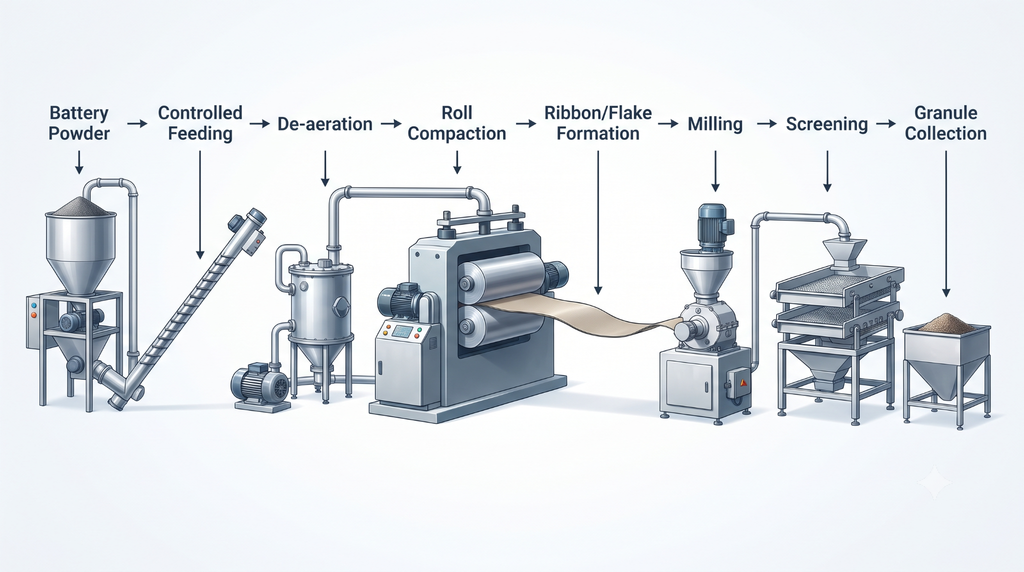
Battery Powder → Controlled Feeding → De-aeration → Roll Compaction → Ribbon/Flake Formation → Milling → Screening → Granule Collection
Unlike conventional wet granulation, roll compaction does not inherently require liquid addition or a dedicated drying stage. This can make it an attractive technology for applications where moisture control is important.
However, not every battery powder will respond to roll compaction in the same way. Material characteristics, chemistry, compressibility, particle size, bulk density, and downstream requirements should be evaluated before selecting equipment.
Fine battery powders can create several handling challenges. They may have poor flowability, generate dust, exhibit inconsistent bulk density, or behave unpredictably during feeding and transfer.
Roll Compaction for Cathode Materials can modify the physical characteristics of suitable powders by mechanically densifying them into a more manageable compacted form.
Potential benefits include:
The actual benefits depend on the powder and process conditions, so application testing remains an important part of equipment selection.
Cathode materials are an important area where controlled powder processing can be evaluated. Materials such as LFP, NMC, LCO, and other cathode formulations have different physical properties and therefore may require different processing conditions.
A Roll Compactor for Lithium Battery Cathode Powder can be used to investigate controlled densification and dry granulation where the material is technically suitable.
During processing, controlled roll pressure brings powder particles together to form a compact. The compact can then be milled and screened to produce granules within a targeted particle-size range.
The objective is not simply to increase particle size. A properly engineered process should provide a material form that performs appropriately during subsequent storage, transportation, feeding, blending, or other downstream operations.
The operation of a Battery Powder Roll Compactor generally involves several stages.
This integrated approach can be incorporated into broader Battery Powder Handling Systems depending on the production requirements.
A roll compactor should not always be considered as an isolated machine. Modern battery production can require controlled movement of powders through several stages.
A complete powder-processing system may include:
Integrating these operations can reduce unnecessary manual powder handling and provide better control over material movement.
This is where Battery Manufacturing Powder Solutions can provide value beyond individual equipment. The objective is to develop a powder-processing workflow that matches the material characteristics, production capacity, containment requirements, and downstream process.
The selection of Roll Compaction Equipment for Lithium-ion Batteries should be based on the actual material and production requirements rather than machine capacity alone.
Important factors include:
Material trials can help determine whether a particular powder is suitable for roll compaction and identify appropriate operating parameters.
Efficient Cathode Powder Handling Solutions should consider the complete journey of the material—from receiving and storage through feeding, processing, collection, and transfer.
For example, a battery-material processing line may combine powder handling with an IBC blender, controlled feeding system, roll compactor, granulator, screening equipment, and material-transfer system.
Chamunda Pharma Machinery Pvt. Ltd. provides powder-processing equipment and solutions that can be configured according to specific industrial requirements. Its battery manufacturing solutions include roll compactors and IBC bin blenders designed for controlled powder processing and handling.
When correctly selected and configured, a Roll Compactor for Battery Manufacturing can offer several process advantages:
Battery manufacturing is a global industry, and manufacturers in India, the USA, Europe, and Brazil are evaluating advanced powder-processing technologies for energy-storage applications.
For international projects, machinery selection involves more than throughput. Manufacturers should also consider plant layout, automation, safety requirements, material containment, electrical specifications, documentation, installation support, and integration with existing production equipment.
Chamunda Pharma Machinery Pvt. Ltd., based in India, provides industrial powder-processing machinery and exports equipment for international manufacturing applications. With experience in powder processing, granulation, blending, and related machinery, Chamunda can support manufacturers evaluating customized battery-material processing requirements.
There is no universal configuration that is suitable for every battery powder. The right solution depends on the material properties and desired process results.
Before purchasing a Roll Compactor for Battery Manufacturing, manufacturers should evaluate:
As battery manufacturing becomes increasingly automated and production volumes grow, effective powder processing is becoming an important part of manufacturing efficiency. A suitable Roll Compactor for Lithium Battery Cathode Powder can help convert difficult-to-handle fine powders into a more manageable compacted and granular form.
From Roll Compaction for Cathode Materials to Integrated Battery Powder Handling Systems, the technology can be considered part of a broader strategy for controlled powder processing, densification, granulation, and material transfer.
The most effective approach is to select equipment around the specific battery material rather than relying only on nominal machine capacity. Powder characteristics, production requirements, target granule properties, containment, automation, and downstream processing should all be considered.
For manufacturers in India, the USA, Europe, and Brazil looking for Battery Manufacturing Powder Solutions or integrated cathode powder processing machinery, Chamunda Pharma Machinery Pvt. Ltd. can provide application-focused equipment configurations based on the customer's material and production requirements.
Explore more insights and updates from our blog section.
Pharmaceutical manufacturing depends on equipment that can consistently produce safe, effective, and high-quality products. From...
Read MoreThe pharmaceutical industry depends on specialized equipment to manufacture tablets, capsules, powders, granules, liquids, and...
Read MoreAs battery manufacturing continues to expand across India, the USA, Europe, and Brazil, manufacturers are...
Read More


 info@chamunda.in
 +91-9512004254 / 55 / 56


