


Granulation is one of the most important steps in pharmaceutical manufacturing. It converts fine pharmaceutical powders into larger, more uniform granules with improved flowability, compressibility, and handling characteristics. Depending on the properties of the formulation, manufacturers generally choose between dry granulation and wet granulation.
Although both methods are designed to improve powder characteristics before tablet compression or other downstream processing, their processes, equipment, advantages, and applications are different.
This guide explains the difference between dry granulation and wet granulation processes, including the advantages, disadvantages, applications, and commonly used granulation equipment.
Pharmaceutical granulation is a size-enlargement process in which fine powders are converted into granules of a controlled size and density.
The main objectives of the pharmaceutical granulation process are to:
Granulation is particularly important when powders have poor flow properties or do not compress effectively on their own.
The two major approaches are:
| Factor | Dry Granulation | Wet Granulation |
| Use of liquid binder | No | Yes |
| Moisture addition | Not required | Required |
| Drying step | Usually not required | Required |
| Main processes | Slugging or roller compaction | Mixing, wet massing, granulation and drying |
| Common equipment | Roller compactor, dry granulator | High shear granulator, fluid bed granulator |
| Suitable for moisture-sensitive materials | Yes | Usually less suitable |
| Suitable for heat-sensitive materials | Yes | Depends on drying conditions |
| Process complexity | Relatively simple | More complex |
| Energy requirement | Generally lower | Generally higher |
| Particle binding mechanism | Pressure/compaction | Liquid binder and subsequent drying |
| Typical application | Moisture- or heat-sensitive formulations | Formulations requiring strong granules and good compressibility |
Dry granulation is a pharmaceutical granulation method in which powders are converted into granules through mechanical compaction without adding a liquid binder.
It is particularly useful for active pharmaceutical ingredients (APIs) and excipients that are sensitive to moisture or heat.
The two traditional approaches to dry granulation are:
Modern pharmaceutical manufacturing commonly uses roller compaction in dry granulation because it provides better process control and continuous production capabilities.
The typical dry granulation process involves the following stages:
1. Powder Weighing and Dispensing: The API and required excipients are accurately weighed according to the formulation.
2. Powder Blending: The ingredients are blended to achieve uniform distribution of the API and excipients.
3. Powder Compaction: The blended powder is compacted using a roller compactor. The powder passes between rotating rollers under controlled pressure.
4. Ribbon Formation: The applied pressure converts the powder into compacted sheets or ribbons.
5. Milling: The ribbons are broken down into granules using a suitable milling system.
6. Granule Classification: The granules can be screened or classified to obtain the required particle-size distribution.
7. Tablet Compression: The resulting granules can then be transferred to a tablet compression machine for tablet manufacturing.
Dry granulation offers several advantages for pharmaceutical manufacturers.
Despite its advantages, dry granulation is not suitable for every formulation.
Some limitations include:
Wet granulation is a pharmaceutical manufacturing process in which powders are mixed with a liquid binder to form wet agglomerates. These agglomerates are subsequently dried and sized to produce granules with the desired properties.
The wet granulation process is widely used for tablet manufacturing because it can improve powder flowability, compressibility, and uniformity.
Common wet granulation technologies include:
The typical wet granulation process includes several stages.
Simple flow:
Powder Blending → Binder Addition → Wet Granulation → Drying → Milling → Screening → Final Blending → Tablet Compression
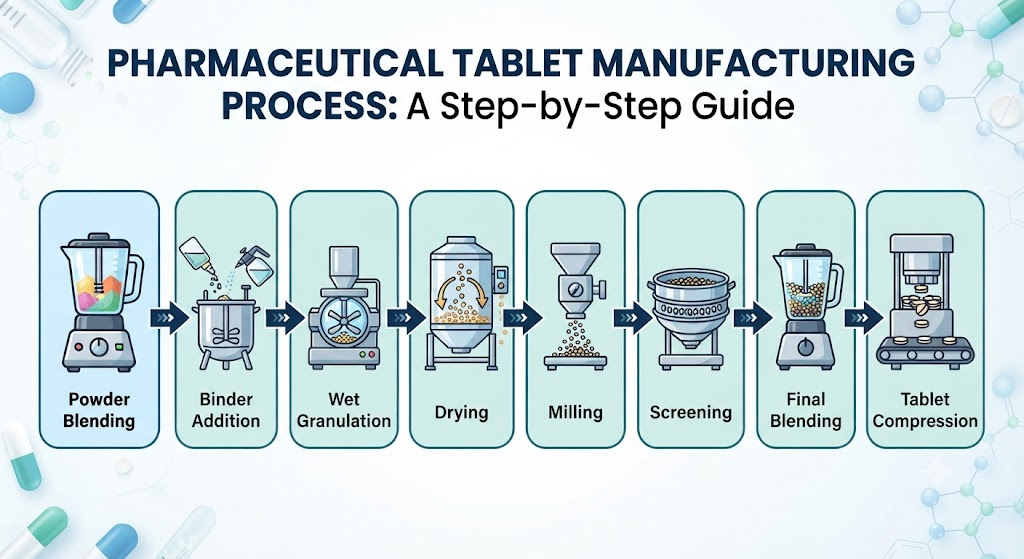
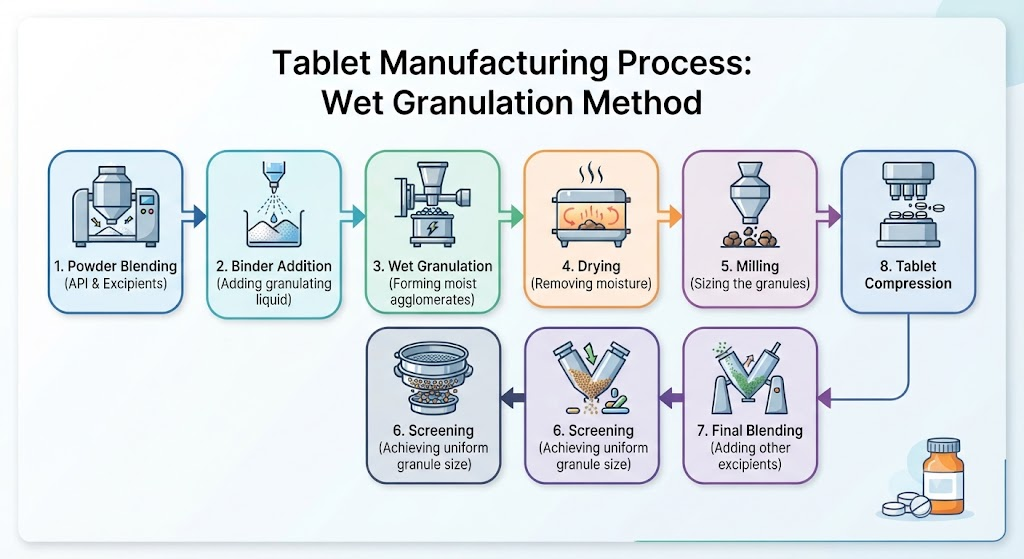
Remark: We can add one of the above two
Wet granulation also has some disadvantages:
The selection between dry and wet granulation depends on the formulation, API characteristics, desired granule properties, equipment availability, and manufacturing requirements.
The final selection should always be based on formulation development studies, material characteristics, process development, and appropriate pharmaceutical manufacturing requirements.
Dry granulation in the pharmaceutical industry is commonly considered for:
Roller compaction is particularly useful when manufacturers need controlled densification and granule production without liquid addition.
Wet granulation in the pharmaceutical industry is widely used for:
Wet granulation can be performed using different technologies depending on production scale and formulation requirements.
The selection of granulation equipment depends on the selected process and desired product characteristics.
Pharmaceutical powder flowability is an important consideration when selecting a granulation method.
Poor powder flow can cause:
Granulation increases particle size and can improve the handling characteristics of fine powders.
However, simply increasing particle size is not enough. Manufacturers must also consider granule density, shape, moisture content, porosity, particle-size distribution, and compressibility.
The tablet granulation process has a direct influence on downstream tablet compression.
Well-designed granules can help provide:
For this reason, granulation should not be considered an isolated operation. It should be developed as part of the complete pharmaceutical manufacturing process.
India has a strong pharmaceutical manufacturing and machinery ecosystem, supplying granulation equipment to pharmaceutical companies in domestic and international markets.
Chamunda Pharma Machinery Pvt. Ltd. manufactures pharmaceutical machinery and granulation equipment in India, supporting pharmaceutical manufacturers with solutions for different production and processing requirements.
The company serves customers in India and exports pharmaceutical machinery to international markets, including Uzbekistan, Germany, Indonesia, Iraq, Israel, Jordan, the Philippines, Russia, the USA, and Vietnam.
When selecting a dry or wet granulation machine, pharmaceutical manufacturers should evaluate factors such as production capacity, material characteristics, granule-size requirements, process controls, cleaning requirements, automation, and integration with other equipment.
What is the main difference between dry granulation and wet granulation?
The main difference is the use of liquid. Dry granulation uses mechanical compaction without adding a liquid binder, whereas wet granulation uses a liquid binder to agglomerate powder particles and requires subsequent drying.
Is dry granulation better than wet granulation?
Neither method is universally better. The appropriate method depends on formulation properties, moisture and heat sensitivity, compressibility, flowability, required granule characteristics, and manufacturing requirements.
What is roller compaction in dry granulation?
Roller compaction is a dry granulation technique in which powder is compressed between rotating rollers to form ribbons or compacted sheets. These are subsequently milled into granules.
What is high shear wet granulation?
High shear wet granulation uses a high-speed mixing system to combine powders with a liquid binder and produce agglomerated granules under intensive mixing conditions.
What is fluid bed granulation?
Fluid bed granulation uses a controlled airflow to fluidize powder particles while a granulating liquid is sprayed onto them. The particles agglomerate and can subsequently be dried within the fluid bed system.
Which granulation process is suitable for moisture-sensitive APIs?
Dry granulation is generally considered when an API or formulation is sensitive to moisture because it does not require liquid binder addition. However, formulation-specific development is necessary before selecting the final process.
Does wet granulation improve tablet quality?
Wet granulation can improve powder flowability and compressibility, which may contribute to more consistent tablet manufacturing when the process is properly designed and controlled.
What equipment is used for pharmaceutical granulation?
Common equipment includes roller compactors, rapid mixer granulators, high shear granulators, fluid bed granulators, fluid bed dryers, mills, and screening systems.
Both dry granulation and wet granulation are important technologies used in pharmaceutical manufacturing. Dry granulation is particularly useful when formulations are sensitive to moisture or heat and when manufacturers want to avoid a conventional drying operation. Wet granulation, on the other hand, can provide excellent improvements in flowability, compressibility, and granule strength for formulations that can tolerate liquid processing.
The right choice depends on the API and excipient properties, desired granule characteristics, tablet requirements, production scale, and overall manufacturing strategy.
For pharmaceutical manufacturers evaluating granulation machinery, Chamunda Pharma Machinery Pvt. Ltd. can be considered for pharmaceutical granulation equipment and machinery solutions manufactured in India and supplied to international markets.
Explore more insights and updates from our blog section.
Pharmaceutical manufacturing depends on equipment that can consistently produce safe, effective, and high-quality products. From...
Read MoreThe pharmaceutical industry depends on specialized equipment to manufacture tablets, capsules, powders, granules, liquids, and...
Read MoreAs battery manufacturing continues to expand across India, the USA, Europe, and Brazil, manufacturers are...
Read More


 info@chamunda.in
 +91-9512004254 / 55 / 56


