


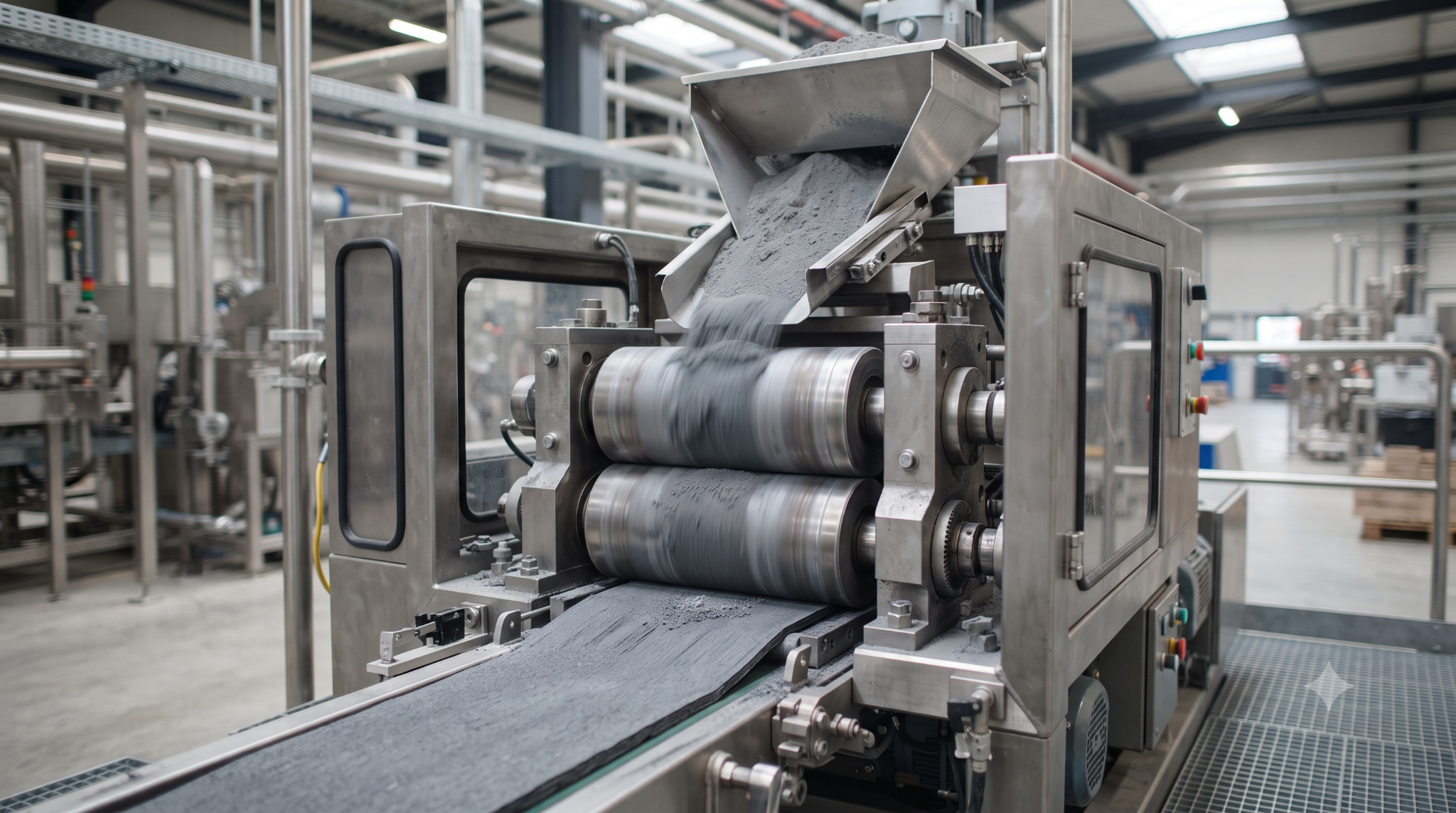
As battery manufacturing continues to expand across India, the USA, Europe, and Brazil, manufacturers are increasingly focusing on efficient powder processing, controlled material handling, densification, and consistent downstream production. Fine battery powders can present challenges such as poor flowability, dust generation, low bulk density, segregation, and inconsistent feeding.
A Battery Material Roller Compactor provides a dry-processing approach for suitable battery powders by applying controlled mechanical pressure between two counter-rotating rolls. The resulting compacted ribbon, flakes, or sheets can subsequently be milled and screened to achieve the required particle-size characteristics.
For battery-material manufacturers looking to improve powder handling and develop scalable dry-processing systems, Roll Compaction for Cathode Materials can be an important technology to evaluate. Chamunda Pharma Machinery Pvt. Ltd. provides powder-processing and roll-compaction solutions for industrial applications, including battery manufacturing.
A Battery Material Roller Compactor is a dry compaction and granulation machine designed to densify suitable fine powders through mechanical pressure.
Unlike conventional wet granulation, roll compaction does not inherently require liquid binders or a separate drying stage. The powder is fed continuously into the compaction zone, where two counter-rotating rolls compress the material into a compacted ribbon or flake.
The compacted material can then pass through milling and screening equipment to produce granules with the desired particle-size distribution.
A typical process can be represented as:
Battery Powder → Controlled Feeding → De-Aeration → Roll Compaction → Ribbon Formation → Milling → Screening → Granules
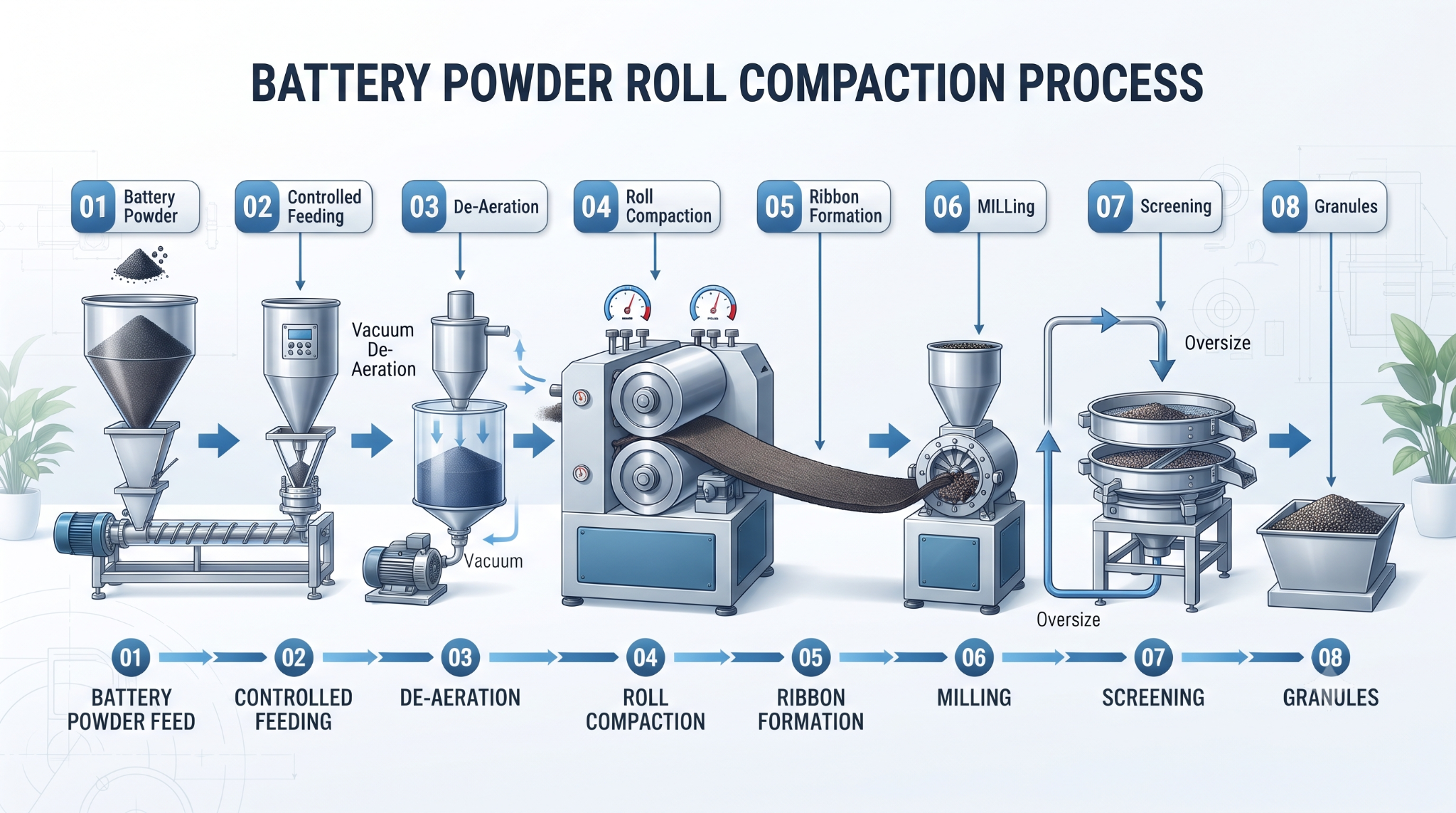
The exact configuration and operating conditions depend on the material properties, production capacity, required density, target particle size, and downstream process requirements.
Battery manufacturing involves several powder-based materials that need controlled handling throughout production. Fine powders may be difficult to transfer, feed, store, or dose consistently.
Challenges can include:
Dry compaction can change the physical characteristics of suitable powders, making them more manageable for subsequent handling and processing.
This is particularly relevant when manufacturers are developing integrated Battery Manufacturing Powder Solutions that connect powder storage, feeding, compaction, milling, screening, conveying, and packaging.
The working principle of a roller compactor is based on controlled powder feeding followed by compression between two counter-rotating rolls.
Battery powder is introduced into the machine through a controlled feeding system. Consistent feeding is important because fluctuations in powder flow can affect the amount of material entering the compaction zone.
Feed-screw speed and powder characteristics therefore need to be considered when establishing suitable operating conditions.
Fine powders can contain entrapped air. During feeding, the system can help reduce the amount of air carried into the compaction zone.
Effective de-aeration can contribute to more consistent material feeding and densification.
The powder enters the gap between two counter-rotating rolls.
As the rolls rotate, mechanical pressure is applied to the powder. The particles undergo rearrangement, deformation and/or fragmentation, followed by consolidation and densification.
This produces a compacted ribbon, sheet, or flake depending on the equipment configuration and material characteristics.
After passing through the roll gap, the densified material exits as a compacted form.
The characteristics of this compact depend on factors such as:
The compacted ribbon or flakes can then be processed through a suitable milling system.
The purpose is to break the compact into smaller particles or granules suitable for the next manufacturing stage.
Following milling, screening can be used to separate particles according to the required size range.
Depending on the process design, oversized or undersized material may be handled through a suitable recycling or reprocessing arrangement.
This creates a controlled dry-granulation route for suitable battery powders.
Roll Compaction for Cathode Materials is an application that manufacturers can evaluate when controlled densification or dry granulation of cathode powders is required.
Battery cathode materials can have different physical and processing characteristics depending on their chemistry and formulation. Examples include LFP, NMC, LCO, and other advanced cathode materials.
A suitable roll-compaction process may help transform fine powder into a more manageable compacted or granular form.
However, not every cathode powder will respond identically to compaction. Material properties, compressibility, moisture content, particle characteristics, target density, and downstream requirements should be evaluated through appropriate trials before final equipment selection.
Potential advantages include:
A Roll Compactor for Battery Manufacturing can be evaluated for several battery-material processing requirements where dry densification or granulation is appropriate.
Fine cathode powders can be compacted to increase bulk density and improve physical handling characteristics.
Compaction followed by milling and screening can produce granulated material with controlled particle-size characteristics.
Granulation can help address certain powder-flow and handling challenges associated with fine materials.
Compacted and granulated powders may be easier to feed into subsequent processing equipment, depending on the material and process.
Reducing the quantity of freely dispersed fine powder can support improved material handling, while enclosed equipment and suitable dust-collection systems remain essential.
Roll compaction technology can be considered for development, pilot-scale, and industrial production applications, with equipment selection based on the required capacity and material characteristics.
Chamunda's battery manufacturing solutions include roll compactors and powder-processing equipment designed to integrate into broader battery-material processing lines.
Selecting a Roll Compaction Machine for Battery Powder requires more than simply selecting a machine based on production capacity.
Important parameters can include:
| Parameter | Why It Matters |
| Powder Characteristics | Determines how the material responds to compaction |
| Feed Rate | Influences consistency of material entering the roll gap |
| Roll Pressure | Controls the mechanical force applied during compaction |
| Roll Gap | Influences compact thickness and density |
| Roll Speed | Affects throughput and processing conditions |
| Powder Moisture | Can influence powder flow and compaction behaviour |
| Bulk Density | Helps determine feeding and densification requirements |
| Target Granule Size | Influences downstream milling and screening |
| Production Capacity | Determines appropriate equipment configuration |
| Dust Control | Important for controlled battery powder handling |
| Automation | Supports consistent and repeatable processing |
| Downstream Integration | Determines how milling, screening and conveying are connected |
The optimum operating parameters should be established according to the actual material and required product characteristics rather than relying on generic machine settings.
A roll compactor should generally be considered as part of a complete powder-processing system rather than an isolated machine.
A comprehensive Cathode Powder Handling Solutions approach may include:
Powder Storage → Bag Unloading → Conveying → Feeding → De-Aeration → Roll Compaction → Milling → Screening → Dust Collection → Material Transfer → Packaging
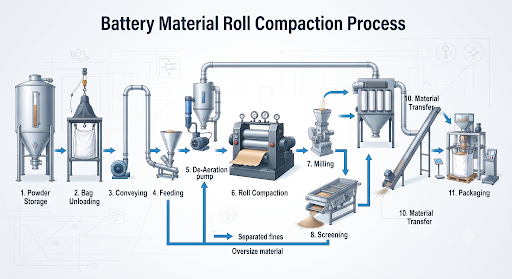
Depending on the production requirements, manufacturers may integrate automated feeding, containment, conveying, screening, and material-transfer systems.
This integrated approach can help manufacturers achieve better control over powder movement throughout the production process. Chamunda's battery manufacturing offering includes roll compactors and IBC bin blenders as part of its battery powder-processing solutions.
Battery manufacturing is expanding across multiple regions, creating demand for reliable powder-processing and material-handling technologies.
Chamunda Pharma Machinery Pvt. Ltd. has more than four decades of experience in powder-processing and pharmaceutical machinery and reports installations across more than 110 locations worldwide. Its portfolio includes roll compactors and solutions covering granulation, milling and granulating, blending/mixing, material handling, and containment.
For battery-material applications, Chamunda provides solutions that can be evaluated for:
The company also provides a dedicated battery manufacturing solution portfolio that includes Roll Compactors for Battery Manufacturing and IBC Bin Blenders.
The appropriate machine configuration depends on the battery material, powder characteristics, production capacity, target density, desired granule size, compaction requirements, containment needs, and downstream process.
As battery manufacturing develops across India, the USA, Europe, and Brazil, efficient powder handling and processing are becoming increasingly important for manufacturers working with fine battery materials.
A Battery Material Roller Compactor provides a dry route for densifying and granulating suitable powders. By combining controlled feeding, mechanical compaction, milling, and screening, manufacturers can develop a more controlled powder-processing workflow.
For suitable applications, a Roll Compactor for Battery Manufacturing may support improved powder handling, increased bulk density, controlled granulation, and dry processing without a conventional wet-granulation and drying stage.
However, equipment selection should always be based on the specific battery material, powder characteristics, production requirements, target granule properties, containment needs, and downstream process.
Chamunda Pharma Machinery Pvt. Ltd. can support battery-material manufacturers in evaluating roll compaction and integrated Battery Manufacturing Powder Solutions for applications in India and international markets including the USA, Europe, and Brazil.
Explore more insights and updates from our blog section.
Pharmaceutical manufacturing depends on equipment that can consistently produce safe, effective, and high-quality products. From...
Read MoreThe pharmaceutical industry depends on specialized equipment to manufacture tablets, capsules, powders, granules, liquids, and...
Read MoreAs battery manufacturing continues to expand across India, the USA, Europe, and Brazil, manufacturers are...
Read More


 info@chamunda.in
 +91-9512004254 / 55 / 56


