


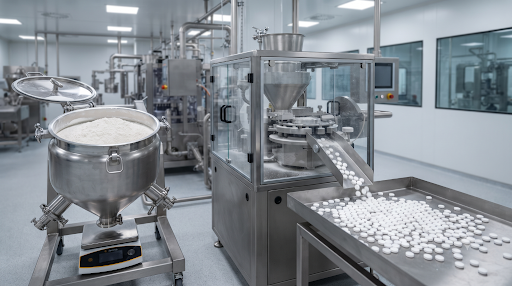
Tablet manufacturing is one of the most widely used processes in pharmaceutical production. From the initial handling of active pharmaceutical ingredients (APIs) and excipients to granulation, compression, coating, inspection, and packaging, every stage plays an important role in achieving consistent tablet quality.
A well-designed Tablet Manufacturing Process must deliver uniformity, reproducibility, efficient material handling, controlled production conditions, and compliance with applicable Good Manufacturing Practices (GMP).
For pharmaceutical manufacturers, choosing the right processing equipment is equally important. Granulation equipment, blending systems, tablet compression machines, coating systems, and packaging equipment must work together as part of an efficient production process.
Chamunda Pharma Machinery Pvt. Ltd. provides pharmaceutical machinery and solid-dosage manufacturing solutions, including dry granulation and tablet compression equipment, serving pharmaceutical and related industries in India and international markets.
The tablet manufacturing process involves converting pharmaceutical powders and other formulation ingredients into a uniform, compressed solid dosage form.
Depending on the formulation characteristics, manufacturers may use direct compression, wet granulation, or dry granulation. The selected process depends on factors such as powder flowability, compressibility, moisture sensitivity, formulation properties, production scale, and the required tablet characteristics.
A typical tablet manufacturing workflow includes:
Each stage has a specific purpose and contributes to the performance, consistency, and manufacturability of the finished tablet.
The process begins with the accurate dispensing of APIs and excipients according to the approved formulation.
The API provides the therapeutic activity, while excipients can perform several functions, including improving flow, binding, disintegration, lubrication, stability, and tablet appearance.
Accurate weighing and controlled material handling are essential because variations in raw-material quantities can affect the final product.
At this stage, manufacturers generally focus on:
The characteristics of the API and excipients also influence which manufacturing route should be selected.
Before blending, raw materials may pass through a sifting or screening process. Sifting helps remove unwanted lumps and can provide more consistent particle size characteristics. This is particularly important when different powders need to be blended uniformly.
Particle size can influence:
Therefore, particle-size control is an important part of preparing the formulation for downstream processing.
After material preparation, APIs and excipients are blended to achieve a sufficiently uniform mixture. The objective is to distribute the active ingredient consistently throughout the formulation while maintaining appropriate powder characteristics. Depending on the formulation and manufacturing scale, pharmaceutical manufacturers may use different types of blending equipment.
Important process considerations include:
A properly blended formulation provides a suitable starting point for the subsequent granulation or compression stage.
Granulation is one of the most important stages in many tablet manufacturing processes. Fine pharmaceutical powders may not always have the flowability or compressibility required for efficient tablet compression. Granulation helps transform powders into larger, more manageable particles with improved processing characteristics.
There are two major approaches:
A High performance roll compactor for pharma industry applications can densify pharmaceutical powders between counter-rotating rollers to form compact ribbons or flakes. These compacted materials are then processed through a granulator to achieve the required granule size.
This approach can be particularly useful for moisture-sensitive, heat-sensitive, or hygroscopic formulations where avoiding liquid addition and subsequent drying can simplify the process.
In a roller compaction process, powder is continuously fed toward the compaction zone. The powder passes between two counter-rotating rolls, where controlled pressure densifies the material into compact ribbons or flakes. These ribbons are then broken down by a crusher and processed through granulation stages to obtain more uniform granules.
The basic process can be summarized as:
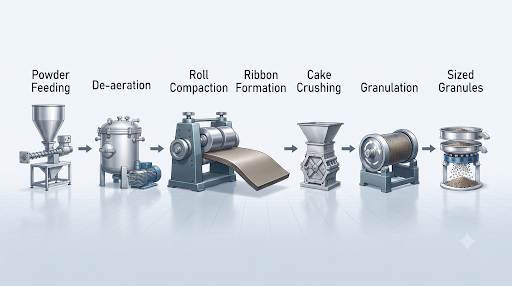
Powder Feeding → De-aeration → Roll Compaction → Ribbon Formation → Cake Crushing → Granulation → Sized Granules
The resulting granules can offer improved flowability, bulk density, and compressibility compared with the original fine powder, depending on formulation and process conditions.
Chamunda's Roll Compactor Cantilever is designed for dry granulation applications and incorporates features such as a twin feed screw system, de-aeration, inline cake crushing, and two-stage granulation. The company states that its cantilever roll compactor is designed for pharmaceutical, API, chemical, and related applications.
Dry granulation can provide several process advantages when it is appropriate for the formulation.
Chamunda describes its cantilever roll compactor as a dry-granulation solution designed to produce uniform granules while supporting efficient processing and GMP-oriented pharmaceutical production.
After granulation, the material may require milling or sizing to achieve the desired particle-size distribution. Granule size has a direct relationship with downstream processing performance. Excessively large or irregular particles may affect flow, while excessive fines can create handling and compression challenges. Controlled sizing helps manufacturers achieve a more consistent granule population before final blending.
Key considerations include:
The target is a granule profile that provides appropriate flow and compression characteristics for the formulation.
After granule sizing, additional excipients may be blended into the formulation. Lubricants and other functional excipients can be added during this stage depending on the formulation design.
The blending process needs to be carefully controlled because excessive mixing can sometimes affect formulation characteristics, while inadequate mixing may result in non-uniform distribution.
The final blend should have suitable:
Once the final blend is approved for compression, it can be transferred to the tablet press.
Tablet compression is the stage where the prepared powder or granules are converted into tablets. A Tablet Press Machine uses punches and dies to compress the formulation into a predetermined shape and size.
During compression, important tablet characteristics may include:
Modern tablet presses can be designed for high-speed production while maintaining controlled compression parameters. A Tablet Compression Machine is therefore a critical component of a solid-dosage manufacturing line.
Chamunda Pharma Machinery offers double rotary tablet press solutions designed for large-batch production. Its product portfolio includes tablet press machines as part of its broader solid-dosage machinery range.
Not every tablet requires coating, but coating can serve several functional and aesthetic purposes. A Tablet Coating Machine can apply a controlled coating layer around tablets depending on the formulation and intended product characteristics.
Tablet coating may be used for purposes such as:
Film coating is widely used in pharmaceutical manufacturing, and coating parameters need to be controlled to achieve consistent results.
The coating process can involve spraying a coating solution or suspension while controlling factors such as inlet air conditions, spray rate, tablet movement, and drying conditions. Chamunda's product range includes automated tablet coating solutions alongside granulation and tablet compression equipment.
Quality control is integrated throughout pharmaceutical manufacturing rather than being limited to the final product.
During tablet production, manufacturers may evaluate parameters such as:
The exact tests and acceptance criteria depend on the formulation, product specification, pharmacopoeial requirements, and applicable regulatory framework. Consistent equipment performance is therefore important for maintaining repeatable manufacturing conditions.
Following compression and coating, tablets may pass through inspection and dedusting stages. Tablet dedusting helps remove loose powder from tablet surfaces before subsequent handling and packaging. Inspection systems may help identify visible defects and support the manufacturer's quality-control process.
Depending on the production line, additional equipment can be integrated to create a continuous and efficient solid-dosage manufacturing workflow.
After the tablets meet the required quality specifications, they move toward packaging.
Common pharmaceutical tablet packaging formats include:
Packaging protects the product from environmental exposure and supports product identification, storage, transportation, and distribution.
An effective tablet manufacturing line therefore extends beyond compression and coating—it connects processing, quality control, and packaging into a coordinated production system.
The appropriate granulation technology depends on the formulation and manufacturing requirements. When evaluating Granulation solutions for tablet manufacturing, pharmaceutical manufacturers should consider:
Chamunda's product portfolio covers multiple stages of solid-dosage processing, including granulation, milling, blending, tablet compression, tablet coating, and packaging solutions.
For pharmaceutical manufacturers, equipment accessibility is an important consideration. A cantilever roll compactor design can provide easier access to critical components for cleaning, inspection, maintenance, and changeover.
Chamunda's Roll Compactor Cantilever is designed with accessibility and maintenance in mind. The manufacturer highlights features including cantilever roll construction, integrated cake crushing and two-stage granulation, de-aeration, and a dust-control-oriented sealing arrangement.
These characteristics can help manufacturers manage:
The suitability of any equipment, however, should always be evaluated against the specific formulation, process parameters, facility design, and applicable GMP requirements.
A successful pharmaceutical production line requires more than selecting individual machines. Equipment needs to work together as a process.
For manufacturers considering a new production line or upgrading an existing facility, important factors include:
A properly engineered process can help manufacturers improve operational consistency while reducing unnecessary process complexity.
Chamunda Pharma Machinery Pvt. Ltd. has been involved in pharmaceutical machinery manufacturing since 1981 and provides equipment and solutions for solid-dosage manufacturing. The company's portfolio includes granulation equipment, roll compactors, tablet press machines, tablet coating systems, blending equipment, and other pharmaceutical machinery.
The company states that its machinery has been installed across more than 110 countries and that its roll compactor equipment has been supplied to international markets. Its published global reach includes markets such as Germany, Indonesia, Israel, Russia, Uzbekistan, India, the USA, Brazil, and other countries across Europe and worldwide.
For pharmaceutical manufacturers evaluating dry granulation equipment, the Roll Compactor Cantilever is one of the solutions available from Chamunda for producing granules suitable for downstream tablet manufacturing.
The journey from API to finished tablet involves a sequence of carefully controlled manufacturing operations. From material preparation and granulation to compression, coating, quality control, and packaging, every stage contributes to the final product.
For formulations that benefit from dry granulation, a High performance roll compactor for pharma industry applications can provide an effective method for powder densification and granule production without conventional wet processing.
The right combination of Granulation solutions for tablet manufacturing, blending equipment, a reliable Tablet Press Machine, an efficient Tablet Compression Machine, and an appropriate Tablet Coating Machine can help pharmaceutical manufacturers develop a more consistent and efficient solid-dosage production process.
As an established Tablet Press Machine Manufacturer in India, Chamunda Pharma Machinery Pvt. Ltd. provides pharmaceutical machinery solutions for manufacturers in India and international markets.
Looking for a roll compactor, tablet press, or complete pharmaceutical machinery solution? Contact Chamunda Pharma Machinery Pvt. Ltd. to discuss your formulation, capacity, and production requirements.
Explore more insights and updates from our blog section.
Pharmaceutical manufacturing depends on equipment that can consistently produce safe, effective, and high-quality products. From...
Read MoreThe pharmaceutical industry depends on specialized equipment to manufacture tablets, capsules, powders, granules, liquids, and...
Read MoreAs battery manufacturing continues to expand across India, the USA, Europe, and Brazil, manufacturers are...
Read More


 info@chamunda.in
 +91-9512004254 / 55 / 56


