


Battery manufacturing depends heavily on the controlled handling, densification, granulation, and transportation of fine powders. Active materials and other powder components used in battery production can present challenges such as poor flowability, dust generation, inconsistent bulk density, segregation, and difficulties during storage or downstream processing.
One technology that can address several of these challenges is roller compaction.
Roller compaction is a dry granulation process in which powder is continuously compressed between two counter-rotating rolls to form a compacted ribbon, sheet, or flake. The compact is subsequently milled and screened to obtain granules with the required particle-size characteristics. Unlike wet granulation, the process does not require liquid binders or a separate drying stage.
For companies evaluating advanced Battery Material Processing technologies, roller compaction can therefore be an important part of a controlled powder-processing strategy.
Roller compaction is a continuous dry granulation technique used to densify powders and improve their physical handling characteristics.
A typical process involves:
The key process variables include compaction pressure, roll gap, roll speed, feed rate, and the physical characteristics of the powder. These parameters can influence the density, strength, particle-size distribution, and overall quality of the resulting granules.
Battery powders often need to be handled under tightly controlled conditions. Fine powders can have poor flow characteristics and may generate dust during conveying, feeding, mixing, and transfer.
Roller compaction changes the physical form of the powder by mechanically densifying it into a compact before controlled milling.
This can provide several potential advantages:
Dry granulation is particularly attractive when introducing moisture or solvents is undesirable. Roller compaction can also be integrated with milling, screening, recycling of fines, and powder-handling systems to create a more controlled processing line.
Fine battery powders can be difficult to move consistently through hoppers, feeders, conveyors, and other processing equipment.
Poor flow can result in:
Granulation increases particle size and can improve the physical handling characteristics of powders. Research and industrial experience with dry granulation show that converting fine powders into granules can improve flow and reduce some of the handling problems associated with fine particulate materials.
A properly designed battery material roller compactor can therefore help manufacturers convert difficult-to-handle powders into a more manageable granular form.
Fine powders can occupy a large volume because of the amount of air between individual particles.
During roller compaction, mechanical pressure forces particles closer together, producing a denser compact.
Higher bulk density can be useful because it may:
The actual density improvement depends on the properties of the powder and the selected process parameters. Roller compaction should therefore be developed around the specific material rather than treated as a one-size-fits-all operation.
Fine particulate materials can generate dust during movement, transfer, and processing.
Dust can create challenges for:
Granulating a fine powder into larger particles can reduce the tendency of the material to behave like a highly dispersible fine powder. Dry granulation is widely used to improve bulk-powder handling and reduce problems associated with fine powders.
For battery manufacturers, this makes Battery Powder Handling an important consideration when designing a powder-processing system.
One of the most significant characteristics of roller compaction is that it is a dry process.
Wet granulation generally introduces liquid and subsequently requires drying. Roller compaction instead uses mechanical pressure to consolidate the powder.
This can be advantageous when:
Dry granulation by roller compaction does not require liquid or a separate drying operation, which can simplify the overall process for suitable materials.
However, battery materials can have highly specific chemical, electrochemical, and particle-property requirements. Material compatibility and process validation should therefore be established through appropriate testing before industrial implementation.
After compaction, the resulting ribbon or sheet can be milled and screened.
This allows manufacturers to develop a target particle-size distribution appropriate for the intended downstream process.
Particle size can influence:
The milling and screening stages are therefore just as important as the compaction stage when designing a complete Battery Material Processing solution.
Consistent powder feeding is important for automated manufacturing.
Extremely fine powders can behave unpredictably in feeders because of differences in cohesion, aeration, moisture, particle shape, and bulk density.
Granulation can modify the physical behavior of the powder and make it easier to convey and feed.
A roller compactor for battery materials can therefore be considered when a manufacturer is experiencing problems related to:
The objective should not simply be to produce larger particles. The goal is to create a controlled material form that performs reliably in the next manufacturing step.
A modern battery powder-processing line may involve multiple operations, including:
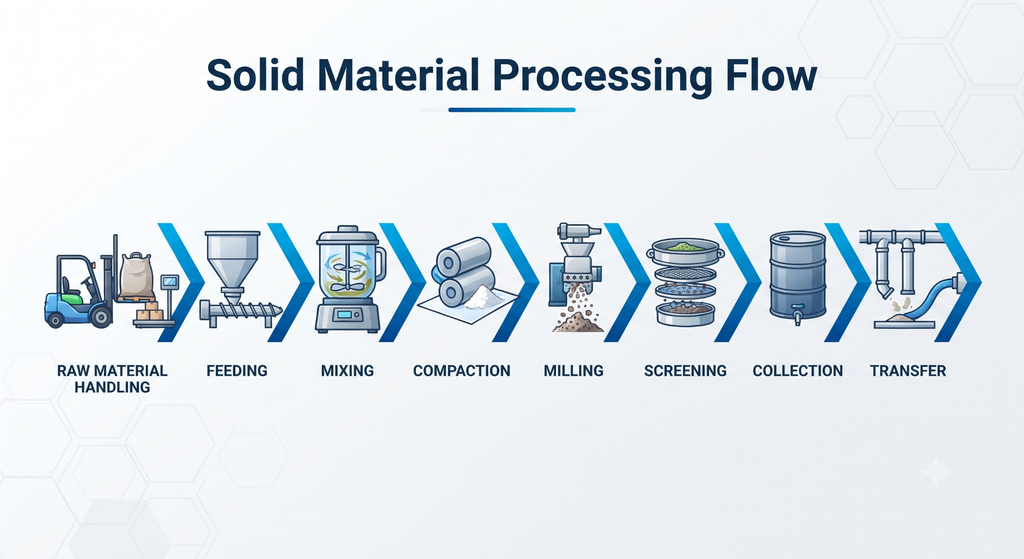
Raw material handling → feeding → mixing → compaction → milling → screening → collection → transfer
Roller compaction can become an important link within this process.
Depending on the material and production requirements, a complete solution may include:
This approach aligns with the broader concept of Battery Manufacturing Powder Solutions, where powder characteristics are managed from the initial feed stage through downstream processing.
The choice between dry and wet granulation depends on the material and process requirements.
| Factor | Roller Compaction | Wet Granulation |
| Liquid addition | Not required | Typically required |
| Drying stage | Not required | Usually required |
| Process type | Dry mechanical compaction | Liquid-assisted agglomeration |
| Powder densification | Yes | Yes |
| Granule production | Yes | Yes |
| Suitable for moisture-sensitive materials | Potentially advantageous | Requires careful evaluation |
| Process complexity | Can be relatively compact | Additional liquid and drying stages |
| Continuous processing | Possible | Possible, depending on system |
Roller compaction is not automatically the best technology for every battery material. Material properties, target granule characteristics, moisture sensitivity, compaction behavior, downstream requirements, and product specifications should all be evaluated.
A typical Roll Compactor for Battery Manufacturing operates through controlled powder feeding and compression.
The powder enters a controlled feeding system.
Stable feeding is important because fluctuations in powder supply can affect the amount of material entering the roll nip.
Fine powder may contain significant amounts of entrained air.
The feeding mechanism helps convey the material toward the compaction zone while promoting consistent powder delivery.
Two counter-rotating rolls pull the powder into the narrow gap between them.
Pressure causes particle rearrangement, deformation and/or fragmentation, followed by bonding and densification.
The compacted material exits the rolls as a ribbon, flake, sheet, or similar compact form depending on the roll design.
The compacted ribbon is broken down into granules using an appropriate milling system.
The milled material can be screened to obtain the desired particle-size range.
Depending on the process design, undersized material may be recycled through the system to improve material utilization.
The result is a controlled dry-granulation process that can transform a difficult-to-handle fine powder into a more manageable granular material.
Selecting the right machine is only one part of successful roller compaction.
Process development should also consider several variables.
Compaction force influences the density and mechanical integrity of the compact.
Excessive force may produce a compact that is difficult to mill or may change the desired material characteristics.
The gap between the rolls influences the degree of compression.
A smaller gap generally results in greater compression, although the relationship depends on powder characteristics and feeding conditions.
Roll speed affects residence time and throughput.
Higher speed can increase production capacity but reduces the time available for compression. Consequently, roll speed needs to be optimized together with feeding rate and compaction force.
Consistent feeding is essential for producing a stable ribbon.
Variations in feed rate can lead to fluctuations in ribbon density and downstream granule properties.
Milling determines how the compacted ribbon is converted into granules.
Screen size, mill speed, mill configuration, and material properties can influence the final particle-size distribution.
Screening helps separate acceptable granules from oversized and undersized particles.
The complete compaction–milling–screening combination should therefore be optimized rather than evaluating the roller compactor independently.
Choosing a Roll Compaction Machine for Battery Powder requires more than comparing machine capacity.
Manufacturers should evaluate:
Important characteristics can include:
The machine should match the required production rate while maintaining the desired powder and granule properties.
Battery powder processing may require carefully controlled containment and dust-management systems. Equipment configuration should reflect the material's characteristics and the plant's safety requirements.
Materials of construction should be selected according to chemical compatibility, wear requirements, cleanliness requirements, and the specific battery material being processed.
Modern systems can incorporate monitoring and control of variables such as:
Better control can support process consistency and repeatability.
A roller compactor should not always be viewed as a standalone machine.
For industrial Battery Powder Processing Machinery, manufacturers may need an integrated process consisting of:
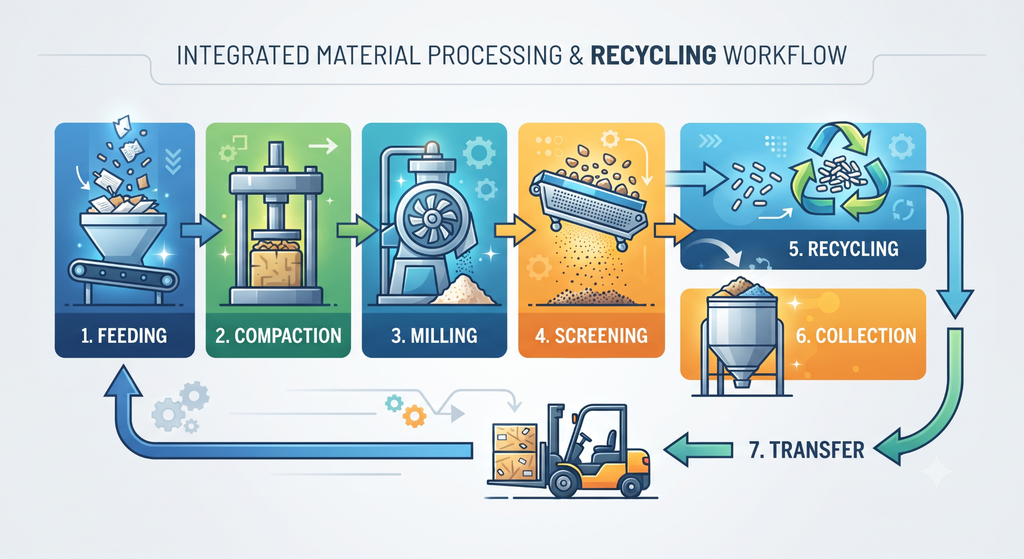
Feeding → Compaction → Milling → Screening → Recycling → Collection → Transfer
Integration can help minimize unnecessary material handling and provide better control over the powder throughout the process.
For example, an integrated system can potentially reduce the number of manual powder-transfer points, helping improve process consistency and containment.
Demand for advanced battery manufacturing equipment is growing across multiple regions. However, equipment selection should always be based on the specific application rather than geographic location alone.
Manufacturers searching for battery material roller compactor Solutions in the USA may prioritize automation, process monitoring, containment, scalability, and integration with existing production lines.
For large-scale facilities, the ability to maintain consistent compaction and granulation performance at industrial throughput can be particularly important.
India's expanding battery manufacturing and materials-processing ecosystem creates demand for reliable and scalable powder-processing technologies.
Companies evaluating battery material granulation equipment solutions in India should consider not only machine capacity but also:
Germany has a strong industrial manufacturing and engineering ecosystem, making process precision, automation, quality control, and equipment integration important considerations.
Companies searching for roller compactor battery materials solutions in Germany may therefore benefit from evaluating equipment based on process repeatability, automation capabilities, engineering standards, and integration requirements.
Battery material processing in Brazil can also benefit from scalable powder-processing and granulation technologies.
When evaluating roller compactor battery materials Brazil applications, manufacturers should consider production capacity, powder characteristics, environmental conditions, maintenance support, and the ability to integrate the equipment with the broader manufacturing process.
Battery Powder Handling is not simply about moving powder from one location to another.
It involves controlling how the material behaves during:
Fine powders can behave very differently from granulated materials.
By converting powder into a controlled granular form, roller compaction may improve flow characteristics and reduce some of the challenges associated with handling very fine powders. Dry granulation is widely recognized as a method for improving powder handling and flow while increasing bulk density.
When correctly engineered for a specific application, roller compaction can provide several benefits:
Although roller compaction offers important advantages, it is not a universal solution.
Manufacturers should investigate:
This is why application testing and process development are important before selecting an industrial system.
A successful process should optimize material quality, throughput, granule properties, containment, energy consumption, and downstream performance together.
Chamunda Pharma Machinery Pvt. Ltd. provides powder-processing and granulation machinery designed for demanding industrial applications.
For manufacturers exploring roller compaction for battery materials, the focus should be on developing an equipment configuration around the specific powder, production capacity, granule requirements, and downstream process.
A suitable solution may involve a combination of:
The right configuration can help manufacturers create a more controlled and efficient Battery Manufacturing Powder Solutions workflow.
A battery material roller compactor is a machine that uses controlled mechanical pressure between two rotating rolls to densify suitable battery-related powders into a compacted ribbon or sheet. The compact can then be milled and screened to produce granules.
A roller compactor first densifies powder through compression. The resulting ribbon or compact is then milled to create granules. In this sense, roller compaction and milling can form complementary stages of a dry-granulation process.
Dry granulation does not require liquid binders or a dedicated drying step. This can be beneficial when moisture or solvent addition is undesirable. However, suitability depends on the specific battery material and downstream requirements.
It can. Roller compaction converts fine powder into a denser compact that can subsequently be milled into granules. Granulated materials can have improved flow and handling characteristics compared with fine powders, although the actual result depends on material and process conditions.
Important factors include powder characteristics, feed rate, compaction force, roll gap, roll speed, material temperature, and downstream milling and screening conditions.
No. Battery materials have different mechanical, chemical, thermal, and particle characteristics. Each material should be evaluated through appropriate testing to determine whether roller compaction is suitable and what process conditions are required.
Efficient powder management is becoming increasingly important as battery manufacturing processes become more automated and production volumes increase.
Roller compaction can improve Battery Material Processing by changing the physical form of suitable fine powders, increasing bulk density, improving handling characteristics, supporting controlled granulation, and enabling a dry processing route without liquid binders or a dedicated drying stage.
For manufacturers considering a roller compactor for battery materials, the most important step is to look beyond the machine itself. Successful implementation depends on the interaction between powder properties, feeding, compaction, milling, screening, containment, automation, and downstream processing.
Whether the requirement involves a battery material roller compactor in the USA, India, Germany, or Brazil, the equipment should ultimately be selected around the specific material and manufacturing objectives.
With the right process design and equipment configuration, roller compaction can become an important component of modern Battery Powder Processing Machinery and integrated Battery Manufacturing Powder Solutions.
Chamunda Pharma Machinery Pvt. Ltd. can help manufacturers evaluate powder-processing and dry-granulation requirements and develop equipment configurations suited to their application.
Explore more insights and updates from our blog section.
Battery manufacturing depends heavily on the controlled handling, densification, granulation, and transportation of fine powders....
Read MoreAs the global battery industry continues to expand, manufacturers of lithium-ion batteries are placing greater...
Read MorePharmaceutical manufacturing industry continues to evolve rapidly in 2026, with increasing demands for automation, GMP...
Read More


 info@chamunda.in
 +91-9512004254 / 55 / 56


