


As the global battery industry continues to expand, manufacturers of lithium-ion batteries are placing greater emphasis on efficient powder processing, material handling, granulation, and downstream production. Cathode materials such as lithium iron phosphate (LFP), nickel manganese cobalt (NMC), lithium cobalt oxide (LCO), and other advanced cathode chemistries often require controlled particle size, improved flowability, reduced dust, and consistent bulk density.
A Roll Compactor for Cathode Powder is one of the key dry-processing technologies used to convert fine cathode powders into denser, more manageable granules or compacts. Unlike wet granulation, roll compaction does not require liquid binders or drying, making it particularly attractive for battery-material processing where moisture control and material purity are critical.
Chamunda Pharma Machinery Pvt. Ltd. provides roll compaction and powder-processing machinery designed for demanding industrial applications, including battery material processing.
A roll compactor is a dry granulation machine that uses mechanical pressure between two counter-rotating rolls to densify fine powder.
In cathode material processing, the machine receives fine cathode powder and compresses it into flakes, ribbons, or compacted sheets. These compacted materials can then be milled and screened to produce granules with the required particle-size distribution.
The basic process can be summarized as:
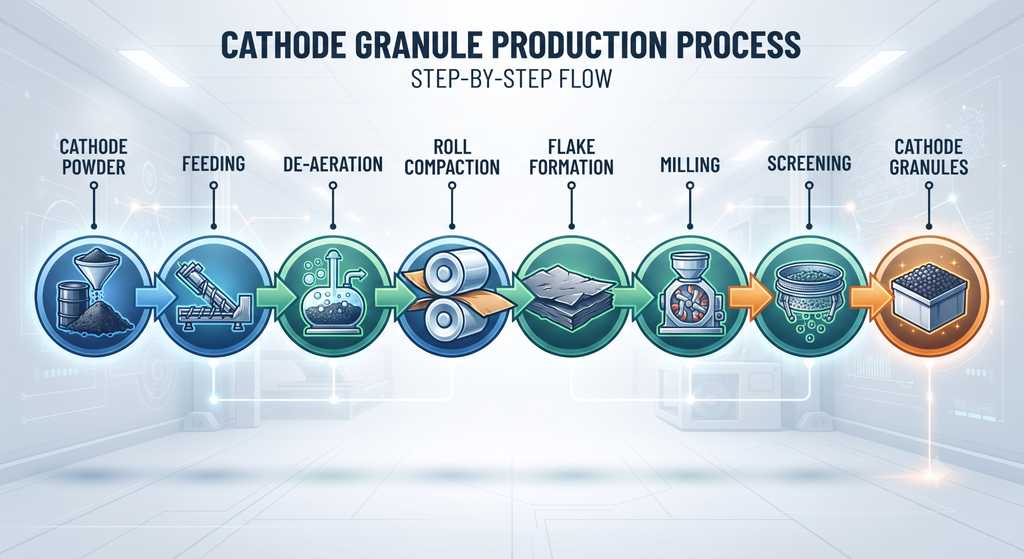
Cathode Powder → Feeding → De-Aeration → Roll Compaction → Flake Formation → Milling → Screening → Cathode Granules
This approach provides a controlled method for improving the physical characteristics of fine powders without introducing water or a conventional wet-granulation drying stage.
Cathode powders can have very fine particle sizes and may exhibit poor flowability, dust generation, segregation, or difficulties during automated feeding and handling.
Granulation can help address several of these challenges.
The working principle of Roll Compaction for Cathode Materials is based on dry densification using two counter-rotating rolls.
Cathode powder is continuously introduced into the roll compactor through a controlled feeding system.
A consistent feed rate is important because variations in powder flow can affect compaction pressure, ribbon density, and final granule characteristics.
Fine powders may contain significant amounts of entrapped air. The feeding system can help remove or reduce air before the powder reaches the compaction zone.
Effective de-aeration contributes to more consistent powder densification.
The powder enters the gap between two counter-rotating rolls.
Mechanical pressure is applied as the powder passes through the roll gap, causing the particles to consolidate into a dense ribbon or flake.
The compacted material exits the rolls as a continuous sheet, ribbon, or flakes, depending on the machine configuration and process conditions.
The compacted material is transferred to a suitable milling system where the flakes or ribbons are broken down into smaller particles.
The milled material can be screened to separate particles according to the required size range.
Oversized particles can potentially be recycled into the process, depending on the process design and material characteristics.
Selecting and controlling the right process parameters is important when processing battery materials.
Important parameters can include:
The optimum settings depend on the cathode chemistry, powder properties, production capacity, and required downstream specifications.
For this reason, equipment selection should be based on actual material trials and process requirements rather than machine capacity alone.
A properly designed Roll Compactor for Cathode Materials can provide several operational advantages.
Roll compaction is a dry granulation technology. It can eliminate the need for liquid addition and the associated drying stage used in wet granulation.
This can be particularly useful when processing moisture-sensitive battery materials.
Because compaction is achieved mechanically, manufacturers can avoid adding a conventional liquid binder solution during the granulation process.
Granules generally have better handling characteristics than extremely fine powders, helping improve feeding and transfer operations.
Roll compactors can apply substantial mechanical pressure to densify powders into a compacted form.
Depending on the equipment configuration, roll compaction can be integrated into continuous powder-processing lines.
Industrial roll compactors are available in different configurations and capacities, allowing the technology to be considered for laboratory development, pilot-scale studies, and larger production applications.
Controlled powder feeding, enclosed processing, and appropriate dust-management systems can help reduce material loss during processing.
Roll compaction technology can be considered for various stages of battery-material powder processing where densification and granulation are required.
Potential applications include:
The suitability of roll compaction depends on the specific battery chemistry and required product characteristics.
Different cathode chemistries have different physical and processing characteristics. Therefore, the machine and process parameters should be selected according to the material being processed.
A roll compactor should not necessarily be viewed as an isolated machine. Efficient battery-material processing often requires an integrated powder-handling system.
A complete Cathode Powder Handling Solutions approach may include:
An integrated system can help manufacturers maintain better process control from powder feeding through final granulation.
There is no single machine that is automatically the Best Roll Compactor for Battery Manufacturing for every application.
The appropriate machine depends on:
Battery-material manufacturers should evaluate equipment based on actual process performance, material compatibility, reliability, scalability, and total cost of ownership.
Selecting a Roll Compactor Supplier for Battery Materials requires more than comparing machine specifications.
Before purchasing equipment, manufacturers should evaluate the supplier's ability to understand the material and process requirements.
Important considerations include:
Battery material suppliers and manufacturers may require more than a basic compaction machine. Compacting Equipment for Battery Material Suppliers can form part of a broader powder-processing solution that includes feeding, densification, granulation, milling, screening, conveying, and collection systems.
A properly engineered system can help address production requirements such as:
The equipment configuration should be developed according to the specific powder and production process.
India is rapidly expanding its battery and energy-storage ecosystem, creating increasing demand for advanced powder-processing technologies.
Manufacturers and battery-material suppliers looking for cathode granulation equipment in India can evaluate dry granulation technologies such as roll compaction for suitable cathode powder applications.
For Indian manufacturers, factors such as local technical support, machine customization, commissioning, spare-parts availability, production capacity, and lifecycle support can be important during equipment selection.
Chamunda Pharma Machinery Pvt. Ltd. can support manufacturers evaluating roll compaction and powder-processing solutions for industrial applications.
The USA has a growing ecosystem of battery manufacturers, cathode active material producers, recycling companies, and battery-material suppliers.
Companies searching for cathode powder granulation equipment in the USA may consider roll compaction when a dry granulation and densification process is suitable for their material.
For US-based battery-material operations, equipment selection may also focus on:
A material trial can help determine whether roll compaction is appropriate for a particular cathode powder.
The demand for battery materials is becoming increasingly global, and manufacturers across different regions are investing in battery-material production and processing capabilities.
Battery-material suppliers and manufacturers in India are developing capabilities across lithium-ion battery materials, energy storage, and related manufacturing processes.
Potential requirements include cathode powder handling, dry granulation, densification, milling, screening, and material-transfer systems.
The US battery ecosystem includes battery manufacturers, cathode active material producers, material suppliers, recycling companies, and technology developers.
Industrial powder-processing equipment can support manufacturers that require controlled handling and granulation of battery materials.
Germany has a strong industrial and automotive manufacturing ecosystem and is an important market for advanced battery technologies.
Battery-material manufacturers and suppliers may require high-quality powder-processing, compaction, granulation, and handling systems for production and development applications.
Brazil has opportunities across the battery, energy-storage, mining, minerals, and advanced-materials sectors.
Companies involved in battery-material processing may require specialized equipment for powder densification, granulation, handling, and downstream processing.
For battery material suppliers in India, the USA, Germany, and Brazil, selecting equipment based on actual material properties and production requirements is essential for achieving consistent results.
Chamunda Pharma Machinery Pvt. Ltd. is an equipment manufacturer serving powder-processing requirements across industrial applications.
For battery-material processing, the company can be considered for applications involving:
The appropriate machine configuration depends on the material characteristics, required capacity, target granule size, compaction requirements, and downstream process.
For battery-material manufacturers, a technical discussion and material trial can help determine the appropriate roll-compaction configuration.
What is a roll compactor used for in cathode powder processing?
A roll compactor is used to densify fine cathode powder through mechanical pressure between two counter-rotating rolls. The resulting compacted material can subsequently be milled and screened to produce granules.
Is roll compaction suitable for lithium-ion cathode materials?
It can be suitable for certain lithium-ion cathode materials, including powders such as LFP, NMC, and LCO, depending on their physical properties and the required final product characteristics. Material trials are recommended.
Does roll compaction require water?
No. Roll compaction is a dry granulation process and does not inherently require water or a conventional wet-granulation step.
Can roll compaction reduce cathode powder dust?
Granulation and densification can reduce the quantity of freely dispersed fine powder during handling. However, appropriate containment and dust-collection systems remain important for safe and controlled processing.
What happens after roll compaction?
The compacted ribbons or flakes can be processed through milling and screening to obtain granules within the desired particle-size range.
How do I choose the right roll compactor for battery materials?
The selection should consider cathode chemistry, powder characteristics, production capacity, compaction pressure, roll configuration, target granule size, feeding requirements, containment, automation, and downstream processing.
Where can I find cathode granulation equipment in India?
Battery-material manufacturers in India can evaluate industrial roll compactors and dry-granulation systems from qualified equipment manufacturers such as Chamunda Pharma Machinery Pvt. Ltd., subject to material testing and process requirements.
Can a roll compactor be used for battery-material production in the USA, Germany, and Brazil?
Yes, roll-compaction technology can be evaluated for suitable battery-material applications in these markets. Equipment configuration, regulatory requirements, safety considerations, and material characteristics should be assessed for each installation.
Roll Compaction for Cathode Materials provides a dry-processing route for densifying fine cathode powders and producing more manageable compacted material for subsequent milling and screening.
When properly engineered, the process can offer advantages such as improved powder handling, increased bulk density, reduced dust generation, and controlled granulation without the conventional wet-granulation and drying stages.
However, selecting the right equipment requires a material-specific approach. Cathode chemistry, powder characteristics, production capacity, compaction requirements, granule-size specifications, containment, and downstream processing should all be considered.
For manufacturers and battery-material suppliers in India, the USA, Germany, Brazil, and other global markets, Chamunda Pharma Machinery Pvt. Ltd. can be considered as a partner for evaluating roll compaction and powder-processing solutions.
Looking for a Roll Compactor for Cathode Powder? Contact Chamunda Pharma Machinery Pvt. Ltd. to discuss your cathode-material processing requirements and evaluate a suitable equipment configuration.
Explore more insights and updates from our blog section.
Battery manufacturing depends heavily on the controlled handling, densification, granulation, and transportation of fine powders....
Read MoreAs the global battery industry continues to expand, manufacturers of lithium-ion batteries are placing greater...
Read MorePharmaceutical manufacturing industry continues to evolve rapidly in 2026, with increasing demands for automation, GMP...
Read More


 info@chamunda.in
 +91-9512004254 / 55 / 56


